Broken Fingers+ · Journal
JESSICA's June 2022 magazine interview
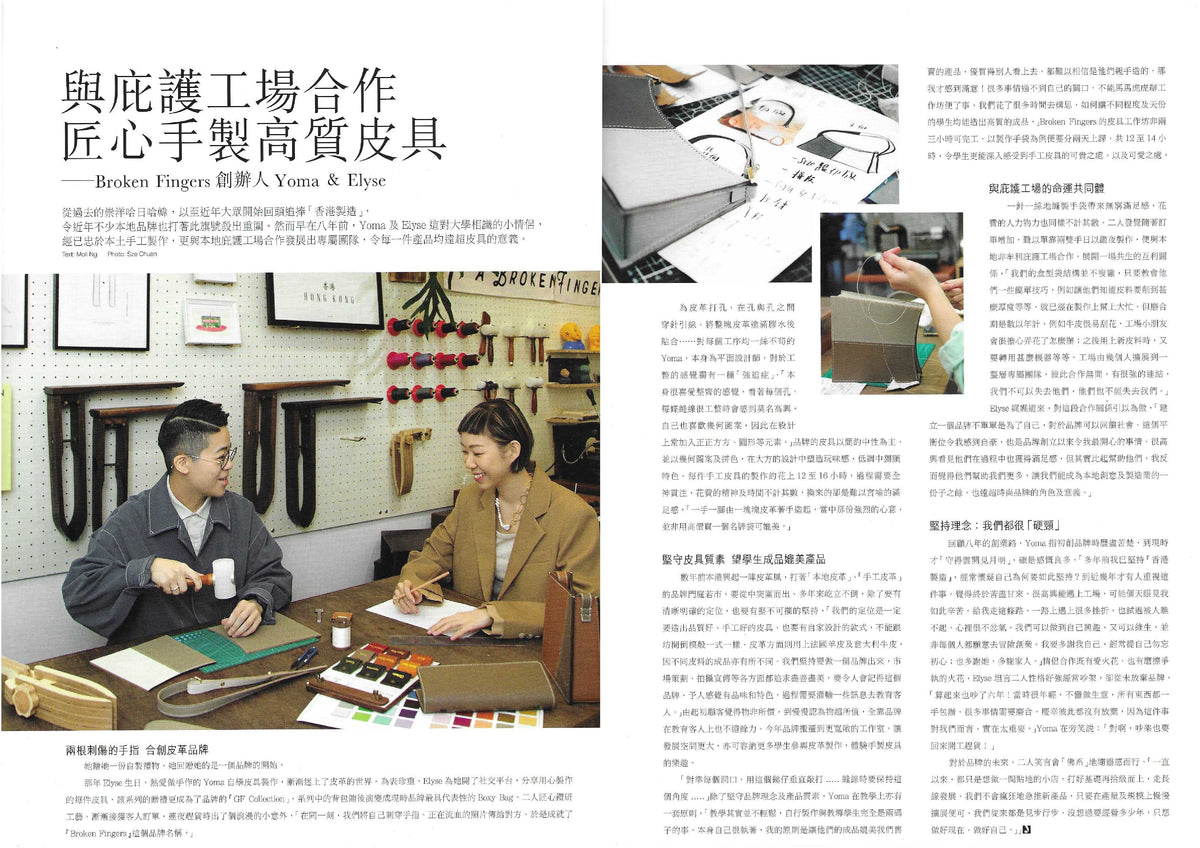
Text: Moli Ng Photo: Sze Chuen 
Partnering with sheltered workshops
High-quality leather goods crafted with meticulous craftsmanship
– Yoma & Elyse, founders of Broken Fingers
From the past trend of idolizing foreign, Japanese, and Korean brands, to the recent trend of people turning back to "Made in Hong Kong," many local brands have used this label to break through the competition. However, as early as eight years ago, Yoma and Elyse, a young couple who met in college, were already committed to local handcrafted production. They even collaborated with local sheltered workshops to develop their own team, making each product far more than just leather goods.
Two injured fingers co-found a leather brand
She gave her a homemade gift, and in return, she gave her the start of a brand.
That year, on Elyse's birthday, Yoma, who loved crafting, taught herself leather crafting and gradually became fascinated by the world of leather. To express his appreciation, Elyse created a social media platform for her, sharing each piece of leather goods he painstakingly crafted. This series of gifts became the brand's "GF Collection," and the backpack in the collection later evolved into the brand's most iconic Boxy Bag. The two dedicated themselves to honing their craftsmanship and gradually received customer orders. While working through the night to meet a deadline, a romantic little accident occurred: "At the same moment, we sent each other photos of ourselves pricking our fingers and bleeding, which led to the creation of the brand name Broken Fingers."
Punching holes in the leather, threading needles between the holes, applying glue to the entire piece of leather and then attaching it... Yoma, a graphic designer, is meticulous in every step of the process and has a unique "obsessive-compulsive" sensibility towards neatness. "I really love the feeling of order. I feel inexplicably happy when I see every hole and every stitch perfectly aligned. I also like geometric patterns, so I often incorporate squares, circles, and other elements into my designs. " The brand's leather goods are mainly simple and neutral, featuring geometric patterns and color blocking, creating a playful feel within a generous design, showcasing a unique character in a low-key manner. Each piece of handmade leather goods takes about 12 to 16 hours to make, requiring complete concentration and countless hours of effort, but the reward is indescribable satisfaction. "The intense dedication involved in creating each piece of leather piece by piece is something that cannot be compared to buying an expensive designer bag."
Upholding the quality of leather goods, students hope their finished products will rival those of professional manufacturers.
A few years ago, a leather craze swept Hong Kong, with brands claiming to offer "local leather" or "handmade leather" attracting huge crowds. To stand out and remain successful over the years, besides having a clear and distinct positioning, unwavering persistence is essential. "Our positioning is to create high-quality, handcrafted leather goods with our own designs. We can't just copy other brands. For leather, we use French sheepskin and Italian cowhide, as the finished products differ depending on the material. We insist on building a brand, striving for perfection in every aspect, from marketing and advertising to creating memorable and tasteful products. This process requires educating customers." From initially feeling overcharged to gradually recognizing excellent value, the brand's dedication to educating its customers is crucial. This year, the brand moved to a more spacious studio, offering greater development space and accommodating more students to participate in leather making and experience the joy of crafting leather goods.
"Aim at each hole and tap vertically with this hammer... Keep this angle when sewing..." Besides upholding the brand's philosophy and product quality, Yoma also has a set of principles for teaching. "Teaching is not easy. Making things yourself and teaching students are two completely different things. I'm very persistent. My principle is to make their finished products comparable to the products we sell, so high-quality that others would find it hard to believe they made them by hand. Only then am I satisfied! Many things can't pass my own test, so I can't just run a workshop haphazardly. We spend a lot of time figuring out how to help students of different levels and talents create high-quality finished products." Broken Fingers' leather workshops can't be completed in just two or three hours. For example, making a handbag requires two days of classes, totaling 12 to 14 hours, allowing students to more deeply appreciate the value and charm of handmade leather goods.
A community of shared destiny with sheltered workshops
The immense satisfaction of meticulously sewing handbags, stitch by stitch, comes with countless hours of labor and resources invested. Realizing that orders were increasing and working day and night was no longer feasible, the two partners collaborated with a local non-profit sheltered workshop, embarking on a mutually beneficial partnership. "Our box-shaped bags aren't complex in structure. Teaching them some simple techniques, like knowing the appropriate thickness for the leather, is a huge help in the production process. However, the adjustment period can take years. For example, cowhide scratches easily, and the workshop's young workers worry about what to do if they get it damaged; then, when new leather is used, they need to switch to different machines, and so on. The workshop has expanded from a few people to an entire dedicated team, working seamlessly together with a strong connection. We can't lose them, and they can't lose us," says Elyse. She spoke at length about how proud she was of this partnership, saying, "Building a brand isn't just about myself; it's about giving back to society. This balance makes me feel incredibly proud, and it's the happiest thing for me since the brand's inception. I'm glad to see that they also find fulfillment in the process, but actually, I feel they've helped us more than they've helped us. They've enabled us to become part of the local creative and manufacturing sector, going far beyond the role and significance of a fashion brand."
Sticking to our principles: We're all very "stubborn".
Looking back on eight years of entrepreneurship, Yoma said that she endured many hardships when starting the brand, and now she has finally "seen the light at the end of the tunnel." She has many feelings to share. "Years ago, I insisted on 'Made in Hong Kong,' and I often wondered why I insisted on it so much. Only in recent years have people paid attention to this, and I feel that the hard work has finally paid off. I am very happy to have met the factory. Maybe God saw how hard I worked and gave me this path. I encountered many setbacks along the way, and I was looked down upon, which made me very resentful. We can do what we are interested in and make a living. Not everyone is willing to take the risk of starting a business. I want to thank myself for always reminding myself not to forget my original intention; I also want to thank her and my family." The partnership between the couple had its sparks of love, but also sparks of friction and arguments. Elyse admitted that the two of them have strong personalities and often quarrel, but they have never given up on the brand. "It's been six years of arguing! We were very young at the time and didn't know how to do business. We did everything ourselves, and there were many things that needed to be worked out. Fortunately, neither of us gave up, because this is really important to us." Yoma A colleague chuckled and said, "Yeah, even after arguing, we have to come back to work and rush to finish the orders!" Regarding the brand's future, the two laughed and said they would take a relaxed approach and follow their inspiration. "We've always just wanted to run a down-to-earth little shop, lay a solid foundation, and then gradually expand in the long run. We won't rush to launch new products; we'll just expand our production volume and scale slowly. We've always taken things one step at a time and never thought about how many years we'd be in business. We just want to do our best in the present and be the best version of ourselves."