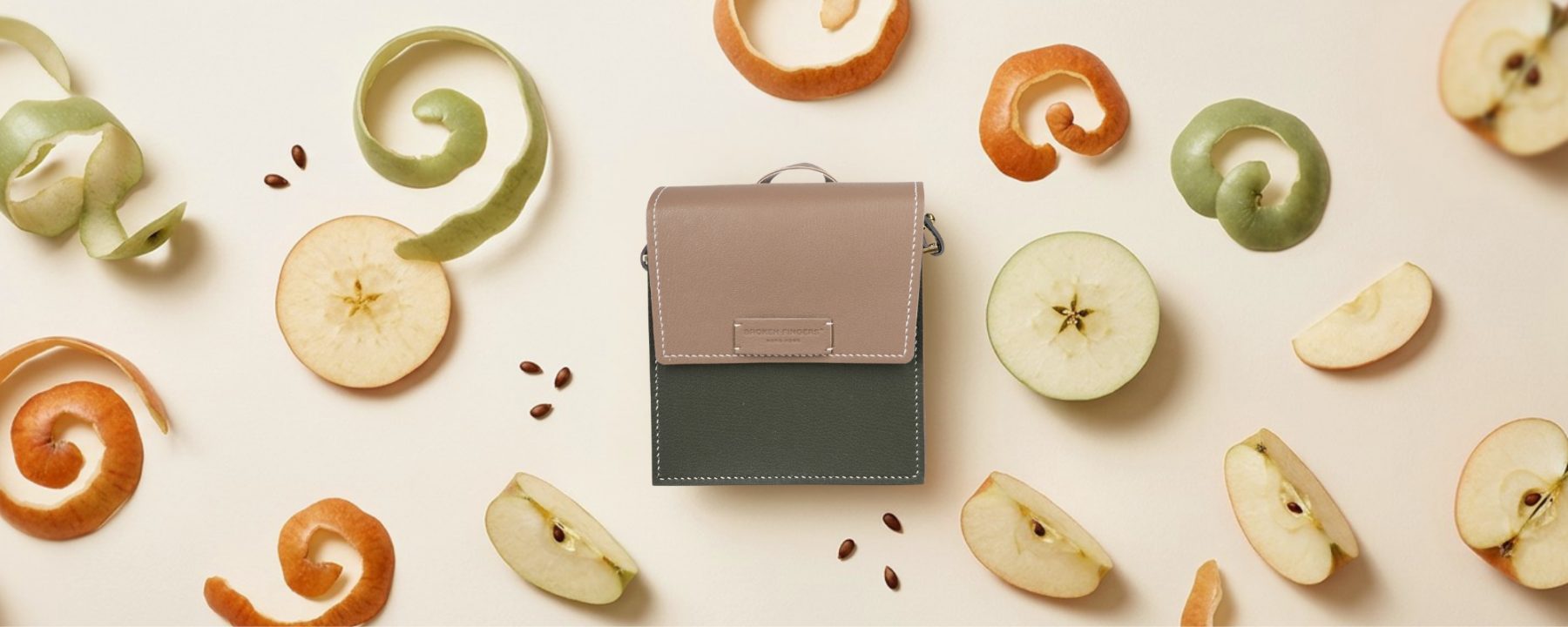
Our leather is made mainly from apple waste recovered from the juicing industry (skin, flesh and seeds). Third-party radiocarbon testing confirms 69% biobased carbon content, and it is USDA BioPreferred Certified. Its biobased portion is biodegradable (supplier data: about 300 days in soil); the material also contains about 31% PU base.
The Square Bag on the right, and what it gives back to the planet:
Carbon footprint
Carbon
CO₂ saved per Square Bag
vs PU −1.23 · vs cowhide −7.7 kg CO₂e
Biobased carbon content
69% (USDA · ASTM D6866-22)
Overall carbon footprint
7.6 kg/m² (PU 16 | cowhide 60–110)
Reduction
vs PU −53% | vs cowhide −88%
Conversion · driving a car 0.25 kg CO₂/km · a mature tree absorbs 21 kg of carbon per year
5–31km driven
vs PU ~ cowhide · ≈ 3 weeks–4.5 months of a tree absorbing carbon
Water saved
Water
Water saved per Square Bag
about 1,540 litres vs genuine leather
Water use of animal leather
about 17,100 litres per kg
Cowhide vs synthetic leather
14–24× the water
Conversion · about 65 litres per shower (around an 8-minute shower) · apple leather uses PU as its carrier, so its water use is similar to synthetic leather
24showers
vs genuine leather · ≈ 1,540 litres of water
Apple pomace
Apple Pomace
Pomace used per Square Bag
about 0.067 kg of apple pomace
Roughly equal to
the juicing waste of 1.7 apples
Global apple pomace per year
about 4 million tonnes (25–30%)
Biodegradable
soil 300 days | marine 900 days
Most apple pomace ends up in landfill, breaking down to produce methane (with 25 times the warming potential of CO₂) · we recover it and turn it into fibre
1.7apples
Juicing waste · diverted from landfill
Eco Calculator
Calculate your real impact.
Pick a piece and see how 69% apple leather compares against PU or genuine cowhide — the same engine used on every product page.
Compare against
🚗
–
CO₂ Avoided
🛢️
–
Petroleum Displaced
💧
–
Water Saved
🍎
–
Apple Waste Rescued
USDA BioPreferred · A verifiable certification
Our apple leather is certified under the U.S. Department of Agriculture (USDA) BioPreferred Program, with its biobased carbon content verified by a third-party lab (Beta Analytic) through ASTM D6866-22 radiocarbon testing.
The remaining 31% is a PU resin carrier, which provides strength, flexibility and water resistance. Paired with a spunlace natural-fibre backing, the material as a whole remains fully biodegradable.
69%
Biobased carbon content
USDA Certified · ASTM D6866-22
The overall carbon footprint is about 7.6 kg CO₂e/m². Petroleum-based PU is about 16, and cowhide genuine leather about 60–110 kg CO₂e/m². Estimated by third-party life-cycle assessment (LCA).
7.6kg
Overall carbon footprint CO₂e/m²
PU 16 · cowhide 60–110 / m²
Fully biodegradable in about 300 days in soil and about 900 days in marine environments (requires a natural-fibre backing). Standard PU is hard to degrade and continuously sheds microplastics in use.
300/900天
Soil / marine biodegradable
Soil / Marine biodegradable
By carbon footprint per m²: about 53% lower than petroleum-based PU and about 88% lower than cowhide genuine leather.
−53/−88%
CO₂ reduction
vs PU / vs cowhide
Raising and tanning each kg of animal leather takes about 17,100 litres of water; cowhide uses 14–24 times the water of synthetic leather. Apple leather uses PU as its carrier, so its water use is similar to synthetic leather.
17,100L
Water saved
per kg vs animal leather · cowhide is 14–24× PU
The global juicing industry produces about 4 million tonnes of apple pomace each year (25–30% of fresh fruit weight), most of which goes to landfill and breaks down into methane (with 25 times the warming potential of CO₂). We rescue it and turn it into fibre.
400萬噸
Global apple pomace per year
25–30% of fresh fruit weight
Material Lifecycle
From apple, to handbag.
Four stages, from pomace recovery to fibre leather-making, the spunlace backing and workshop inspection. Every step is visible.
Apple Pomace · Recovered Waste
The global juicing industry produces about 4 million tonnes of apple waste each year (25–30% of fresh fruit weight), most of which goes to landfill and breaks down into methane (with 25 times the warming potential of CO₂).
We rescue it from the waste stream, then low-temperature dry and grind it into apple fibre.
Bio-Leather · Plant-based
Apple fibre and plant-based fibres are blended with PU resin, with radiocarbon testing (ASTM D6866-22) confirming 69% biobased carbon content and USDA BioPreferred certification.
Spunlace · Hydroentanglement
The backing uses spunlace technology, mechanically entangling fibres with high-pressure water jets, with zero chemical binders and zero glue. Paired with natural fibres, the whole material is fully biodegradable.
Workshop QC · Inspection
Every hide is inspected at the workshop for evenness, flexibility, texture and water resistance.
Any hide that does not meet standard is rejected in full.
Environmental Impact
Where the impact actually is.
01
Waste-to-Material
Each year 4 million tonnes of apple pomace go to landfill worldwide, breaking down into methane (with 25 times the warming potential of CO₂). For every kilogram of apple waste our supplier uses in place of PU, about 5.28 kg CO₂ of emissions are saved.
02
Water Saved
Raising and tanning 1 kg of animal leather takes about 17,100 litres of water (the equivalent of 70 bathtubs). Cowhide uses 14–24 times the water of synthetic leather. Apple leather uses PU as its carrier, so its water use is similar to synthetic leather, lowering the overall water footprint by about 95%.
03
No Chrome Pollution
About 90% of animal leather worldwide is chrome-tanned, and hexavalent chromium (Cr⁶⁺) is classified by the International Agency for Research on Cancer as a Group 1 carcinogen. This material has hexavalent chromium of < 3 PPM, meeting the EN71-3 infant safety standard.
04
Lower Earth Impact
Apple leather fully breaks down in about 300 days in soil and about 900 days in marine environments, and the waste can be converted into organic fertiliser. Standard PU is hard to degrade and continuously releases microplastic fibres in use.
Side by Side
Materials compared.
Materials Comparison · Side by SideApple LeatherAppleAnimal LeatherAnimalSynthetic PUSynthetic
Item
Apple LeatherApple
Animal LeatherChrome-tanned · Animal
Synthetic PUSynthetic
Animal content
✓0%
✗100%
✓0%
Biobased content
✓69% USDA
—
✗0%
Carbon footprint kg CO₂e/m²
✓~7.6
✗60–110
16
Fully biodegradable
✓soil 10 / marine 30 months
5–10 years (with chrome-tanning pollution)
✗50–100 years
Heavy-metal tanning
✓not needed (hexavalent chromium <3 PPM)
✗chrome-tanned (carcinogen)
✓not needed
Made from waste
✓apple waste + spunlace fibre
✗raw material
✗petrochemical feedstock
Durability
5–10 years of normal use
✓10+ years (most durable)
✗peels after 2–5 years
Scratch resistance
△marks soften over time
△marks easily but repairable
✗coating scratches easily
Water resistance
✓PU base is naturally water-repellent
✗water-sensitive, leaves marks
✓fully waterproof
Microplastic shedding
✓biodegrades, no residue
—
✗continuously sheds microplastics
Infant contact EN71-3
✓compliant
△depends on tanning
△depends on coating
Care
How to use it, so it lasts longer with you.
The base of apple leather is PU resin blended with 69% plant fibre.
Unlike animal leather, it does not need conditioning oils or wax;
unlike plastic, it dislikes prolonged soaking and sun exposure. Here are practical tips for using this material.
4 Practical Habits
1
Everyday wipe: dry or damp cotton cloth
Wipe dirt gently with a lightly damp cotton cloth. If needed, use a tiny amount of a mild neutral cleanser (such as baby wash) diluted in water, wipe gently, then dry immediately with a dry cloth.
2
If it gets wet: blot and air-dry
The PU base is water-repellent, so just blot raindrops away. If a large area gets wet, blot with tissue, then let it air-dry in a cool, ventilated place. Do not use a hairdryer or hot air.
3
Storage: breathable cotton bag, lightly stuffed
Store it in a breathable cotton bag (not a plastic bag, which traps moisture and causes mould). Stuff it lightly with soft padding to keep its shape and avoid deformation from long-term pressure. Keep the storage area dry and ventilated, away from heaters and kitchen fumes.
4
Keep out of direct sun
Brief sun exposure is fine, but avoid prolonged exposure (over 8 hours). UV light accelerates ageing of the PU base, dulling and hardening it.
5 Things Not to Do
✗
Do not use alcohol, disinfectant or chemical solventsNo alcohol, disinfectant or solventsthey damage the PU surface coating
✗
Do not use a hairdryer or hot airNo hairdryer / hot airPU is heat-sensitive and will blister and deform
✗
Do not use regular animal-leather conditioning oils or waxNo leather oils or waxPU does not need oil conditioning and will absorb unevenly, leaving blotches
✗
Do not seal it in a plastic bagDon't seal in a plastic bagpoor ventilation traps moisture and causes mould spots
✗
Do not soak it in water for over 30 minutesDon't soak over 30 minthe plant fibres will swell and deform
From waste to your hands, every step is made by people.