Broken Fingers+ · Journal
Hand-Stitched Leather Goods vs Machine-Stitched
You can often feel the difference before you can name it. Pick up a wallet, card holder, or pouch, and something either feels calm and intentional or a little too uniform, too fast. That instinct is usually what people are responding to when they compare 手縫皮件 vs 機縫皮件. The question is not simply which one is better. It is what kind of making, wearing, and meaning you want your leather piece to carry.
For everyday buyers, gifting shoppers, and anyone who cares about design with substance, this comparison matters because stitching affects more than appearance. It changes how a piece ages, how it handles pressure, how easy it is to repair, and why it costs what it costs. If you have ever wondered whether hand stitching is truly worth it, the honest answer is sometimes yes, sometimes no. It depends on what you value.
Hand-stitched leather goods vs machine-stitched: what actually changes
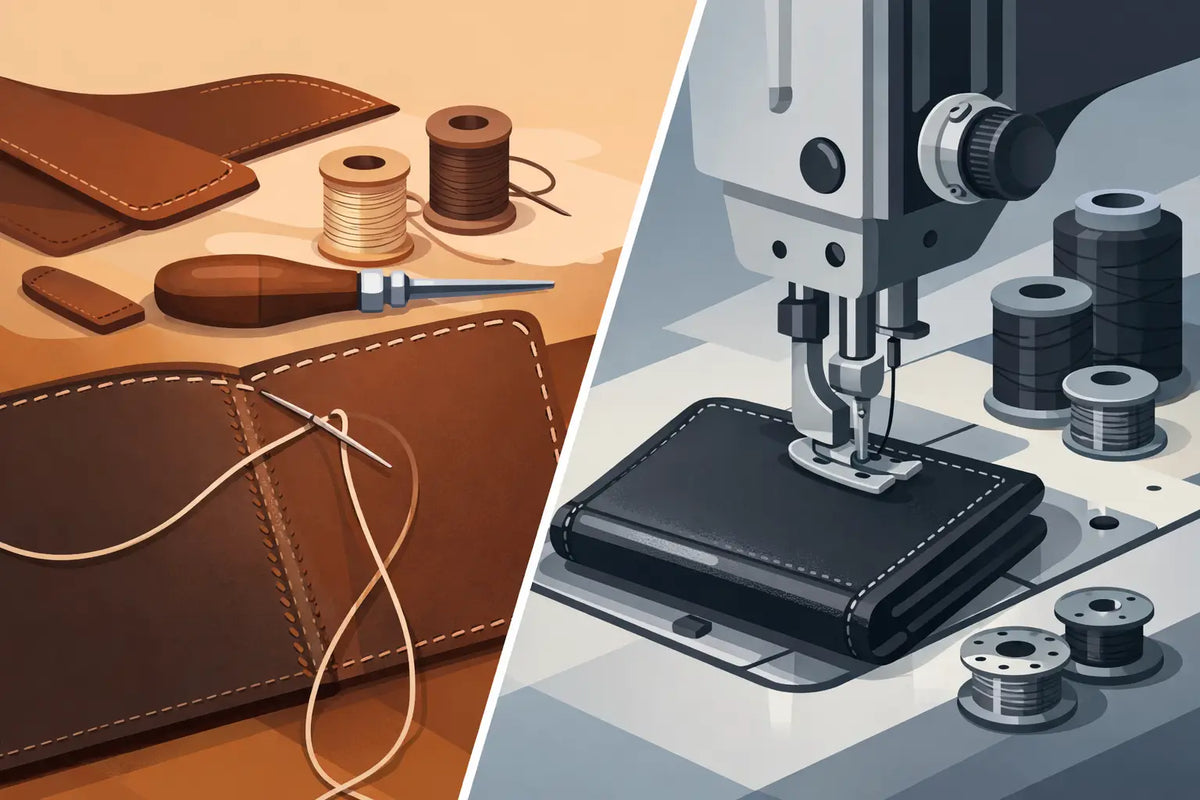
The biggest difference starts with how the stitch is formed. In hand stitching, artisans usually use a saddle stitch, made with two needles crossing through each hole from opposite sides. This creates a lock at every stitch point. In machine stitching, a sewing machine typically uses a top thread and a bobbin thread to create a faster, more standardized seam.
That technical difference sounds small, but it has real consequences. A hand-stitched seam tends to hold together better when one part of the thread gets damaged, because each stitch is individually secured. A machine seam is efficient and consistent, but if the stitch line starts to fail, the seam can sometimes unravel more easily.
This does not mean machine stitching is poor quality. A well-made machine-stitched leather item can be durable, beautiful, and entirely right for daily use. It simply means the construction logic is different.
Why hand stitching is often associated with craftsmanship
When people talk about hand-stitched leather goods with admiration, they are usually responding to labor, precision, and pace. Every hole is prepared with care. Every stitch is pulled by hand. Tension is adjusted continuously, not just set by a machine. That slower process leaves room for judgment, and judgment is part of craft.
You can often see it in the details. Corners may feel more considered. The stitch line may have a subtle rhythm rather than mechanical perfection. Instead of looking mass-produced, the piece feels made by someone who was present through the whole process.
That presence matters emotionally too. A hand-stitched leather piece often carries a sense of human attention that goes beyond utility. For some people, that is exactly what makes a card holder or passport cover feel personal enough to keep for years or meaningful enough to give as a gift.
Durability is not marketing language - it is construction
If you are choosing between 手縫皮件 vs 機縫皮件 for long-term use, durability is usually the first practical concern. In general, hand stitching has an edge in seam strength, especially for small leather goods that get opened, bent, and handled constantly, like wallets and coin pouches.
Because saddle stitching locks each stitch individually, damage in one area does not always compromise the whole seam. That can be a real advantage over time. A machine-stitched seam, while often neat and strong at first, may be more vulnerable if thread tension weakens or a section gets cut or abraded.
Still, durability is never about stitching alone. Leather quality, edge finishing, pattern design, and how the item is used all matter. A carefully made machine-stitched bag can outlast a poorly made hand-stitched one. Stitching is one part of the story, not the whole story.
The visual difference is subtle, but people notice it
Machine stitching usually looks cleaner and more uniform. For buyers who prefer a sleek, polished finish, that can be very appealing. It suits minimalist designs and products meant to feel crisp, modern, and standardized.
Hand stitching often looks warmer. The angle of the stitch, the slight variation in tension, and the way the thread sits in the leather can make the piece feel more alive. Not messy, not imperfect in a careless way, but human. That visual softness is part of why hand-stitched leather often ages beautifully. As the leather develops character, the stitching continues to feel like it belongs.
This is one reason many people are drawn to hand-stitched small accessories. These are objects we touch every day. A little warmth in the making goes a long way.
Why the price difference is real
Hand-stitched leather goods usually cost more, and not because the label wants to sound premium. The process simply takes much longer. Cutting, punching, stitching, edge finishing, and checking every detail by hand requires time, training, and patience.
That cost also reflects a different production philosophy. Hand stitching is not built for speed or volume. It is built for attention. When you buy a hand-stitched piece, you are paying for labor, skill, and a production rhythm that leaves more room for care.
Machine-stitched leather goods are often more accessible in price, which makes them a practical choice for many shoppers. That accessibility is not something to dismiss. Good design should not only belong to those with the highest budget. Sometimes a machine-stitched item is the right answer because it fits your needs without asking you to overbuy.
Which one makes more sense for gifts
If you are buying a gift, hand stitching often carries more emotional weight. People may not know the technical term saddle stitch, but they can feel when something has been made slowly and thoughtfully. A hand-stitched wallet, card holder, or passport case tends to say, I chose something with care.
That said, the best gift is not always the most labor-intensive one. It is the one that fits the person. Some recipients prefer a smoother, cleaner, more understated machine-finished look. Others care most about function and slimness. The right gift lives at the intersection of aesthetics, daily habits, and meaning.
If the story behind the item includes skilled makers being seen for their ability and craft, that can deepen the gift without making it sentimental. The object still has to perform well. Meaning works best when it is carried by quality.
Hand-stitched leather goods vs machine-stitched for everyday use
For daily carry, there are a few good questions to ask yourself. Do you want something that may show character more naturally over time? Do you enjoy knowing how an object was made? Are you comfortable paying more for craftsmanship and repair potential? If yes, hand stitching may feel right from the start.
If you prioritize affordability, streamlined appearance, and easy replacement, machine stitching may be the better fit. There is no failure in choosing practicality. Not every purchase has to be heirloom-minded.
Small leather goods are especially personal because they sit so close to routine. Your wallet is opened dozens of times a week. Your pouch gets tossed into bags, taken to cafés, set on desks, and carried through travel. The more intimate the use, the more noticeable the construction becomes.
What this choice says about values
There is also a quieter layer to this conversation. Choosing hand stitching can be a way of choosing slowness in a fast retail culture. It can mean valuing workmanship over scale, dignity over invisibility, and process over pure efficiency.
That is part of why handcraft resonates so deeply when it is connected to real people and real opportunity. At Broken Fingers+, hand-stitched leather is not only about aesthetics or tradition. It is also about what becomes possible when craft is taught, practiced, and recognized as meaningful work. A finished piece can carry function, beauty, and the proof of someone’s ability all at once.
For value-driven shoppers, that changes the purchase. You are not only asking whether the stitches are stronger. You are asking what kind of making you want to support.
So which should you choose?
Choose hand-stitched leather if you want stronger stitch-by-stitch construction, visible craftsmanship, and a piece that feels personal from the first touch. Choose machine-stitched leather if you want consistency, efficiency, and a lower price point that still serves daily life well.
Neither option deserves lazy stereotypes. Hand stitching is not automatically superior in every category, and machine stitching is not automatically soulless. What matters is honesty. How was it made, why was it made that way, and does that align with how you live?
The best leather piece is the one you keep reaching for, year after year, because it fits your hand, your routine, and your values. When a product does that, the stitches are doing more than holding leather together. They are holding a small part of your story, too.